
Categories
Archives
Search
Category: Management

A professional approach that builds trust
Here’s a question for you: What is the difference between “nagging” and “gentle persistence”? I am not sure I have the exact answer. I do know that when someone nags me, I can get irritated, yet if they persist in a gentle and gracious way, I am much more motivated.
A couple years ago I sent an email to a person in a marketing company. He was doing a project for me, and I had something I wanted to add. When I wrote Jason, I forgot to copy the president – something which I had agreed to always do. A short time later, I received this email from the president:
“Hi Steve: Just a friendly reminder to “cc” me when requesting projects from the staff. I really don’t mind, but if I know they are working on a project for you, I won’t interrupt them with other projects if i can avoid it. Thanks, J
I was impressed. Not only was the approach friendly and respectful, she took the time to state the WIFM. (What’s in in for me) I was not upset by this email. Quite the contrary, I was upset with myself for the error of omission. I promised myself I would stick to my commitment and always “cc” the president. I have kept that commitment.
This was a good approach that received my full cooperation. What if the email had a nasty tone like “As mentioned previously, I expect a “cc” when…” The president chose the high road. She was probably irritated that I forgot, then quickly shifted to solving the problem. That’s professionalism!

Learn from mistakes…grow from successes
I have coached and trained almost my entire career. Helping others achieve growth means leading people out of their comfort zones so that they may enjoy a desired new ability. Here is a key fundamental: We learn from our mistakes and we grow from our successes. I share this example:
A couple weeks ago on Christmas day a neighbor boy came to our door and asked if he could use our driveway to practice learning to ride his new bike. His driveway led into the street, and ours ended in our yard…much safer!
He mounted his new bike with his sparkling spokes and was ready to take the plunge. Since I spend so much time coaching people, I couldn’t resist offering a couple tips: First, I had him start with the right pedal up so that he could get a good start. Second, I encouraged him to pedal hard while looking straight ahead. Don’t look down! He took off and was tempted to look down. I stopped him and yelled, “Keep looking straight ahead!” He did. He had a success and made it all way to the end of the driveway. We repeated it three times, and we had three good outcomes. There were no falls. He was excited, and ran in to tell his Mom and Dad.
My goal in coaching him was not to have him learn by mistakes, rather to grow from his successes. Let’s face it, falling off a bike isn’t too motivating for most people. The lesson learned here is while we may learn from our mistakes, we grow from our wins. Think about it: If the only way we learned was from making mistakes, then the person in Illinois who had the most traffic accidents would be considered the best driver. Would you want to drive with him/her?

Growth-oriented teams are not afraid to make mistakes
Several years ago I was working with a successful business owner (Joe) who was looking to expand his business considerably. He knew that meant hiring more people, and counting on them to be an extension of his beliefs in hard work, integrity, and doing things with excellence.
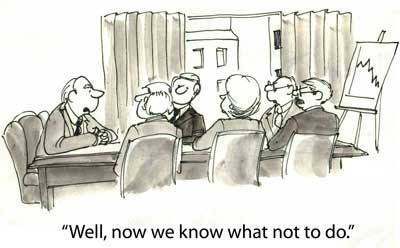 Moving forward, there was one thing that bothered Joe…Mistakes! When members of his team made a mistake, there was a tendency to blame others, make excuses, or “sugar coat” things. When any of these things would happen, solving the problem would become more difficult and the consequences would be more serious. Joe asked me to help him understand the resistance of his team members to own up to mistakes and report them quickly.
After talking with Joe’s team members, the cause of this problem became very apparent: Joe’s team was afraid to admit it when they made a mistake, and this fear caused them to hesitate coming forward. Joe is a “right-right” person and when his team members fell short with a customer, he would go into a fit.
When I reported my findings back to Joe, he said, “When I have a tantrum, I am not upset at someone, I am just mad we fell short with a customer.” I replied, “That may be so, but your people think you are mad at them.” Problem solved! We had a team meeting and Joe explained to his team what he had told me. His staff agreed to give Joe permission to have a tantrum when a mistake was made. Once he is finished letting off steam, they all get busy and solve the problem. Joe’s people are now quick to own up to to their errors and communicate them right away. These changes have led to a stronger, more confident, and collaborative team. They also have more fun!

Great companies stay creatively alive!
I’ll start with two words: Apple and Disney. These names don’t just stand for some products or services. When we hear these names it can trigger the “kid” in us. For decades these companies have never seemed to lose their enthusiasm and continuous profitability. Instead of becoming too set in their ways, they believe in the old maxim, “Yesterday’s methods produce yesterday’s results”. Apple and Disney are driven by innovation and constant reinvention. What does it take to have these qualities? Perhaps we need to go back to our childhood to find out.
Many years ago, NASA did a study of 1600 individuals from infancy to adulthood. The goal was to measure the percentage of creativity in all the actions they observed:
Ages 1-5: 98%
Ages 6-10: 35%
Ages 11-15: 12%
Ages 16-20 5%
We know these observations are true. Just watch an infant during their waking hours. A couple of weeks ago I was babysitting for my 8-month old grandson. He was in the playpen and for all his time he was playing with toys, practicing his crawling, or keenly noticing his surroundings. Before we know it, he will be attending school, and will begin the process of learning the rules of life. He will also begin to sacrifice some of his creativity for compliance.
What can we do as teachers, coaches, bosses, and parents to make sure we tap into the creativity of our team member? First, we need to build a working environment that encourages idea fluency. To do this, we start with brainstorming. This step focuses on the quantity of ideas – not the quality. We get all our thoughts on the table. To successfully perform this step, we need to outlaw any “judgment” or “red-light” language. Here are some examples:
- “We tried that once”
- “We’re different”
- You can’t…”
- “It won’t…”
- “We have never…”
- “We don’t do things that way”
- “It’s not practical”
- “It’s against tradition”
- “That is not our responsibility”
- “It’s too…”
- “We don’t have time”
- “We’re not ready for that”
- “Let’s give it more thought”
- “They would never go for it”
- “Not THAT again!”
- “Where did you dig that one up?”
- “We’re doing alright”
- “That’s not us”
These “red-light” phrases should be avoided when you are in the brainstorming stage to get all the ideas written down. No judgment is allowed! (That comes in a later step when we are working towards solutions) Remember to activate creativity by starting with all the ideas…without judgment. It is fun, and you’ll feel like a kid again.

Working with focus in a “free-for-all” world
Last week I was working with a team on time management skills. We began by looking at a list of common barriers to good time management. Each participant reviewed the list and chose the barrier that they thought was the biggest threat to using their time productively. By far the most common barrier was DISTRACTIONS!
According to research from McKinsey, the average employee gets interrupted 50-60 times a day with emails, texts, phone calls, drop in visitors, sports scores, stock market updates, and “click bait” just to name a few. Expert’s say if we can get focused and stay focused, we can double our productivity (Assuming we are working from written goals)
A couple of years ago, I did an experiment. I had a large report to put together that included 18 separate assessments. Just for fun, I worked on one of the assessment without interruption, and measured the time. I then took this time and multiplied it by 17. (The number of remaining assessments) I took that projected time and made it a goal. I stayed focused, allowed no interruptions, and completed the project in 1/2 day. Normally it would have taken me a full work day. By not allowing distractions, I was able to get into the “flow state” and stay there without my thoughts straying.
I often hear people say, “I’m working more now that I was 10 years ago”. We may be spending more time at work, but are we getting more work done? If we want to double our productivity by greatly reducing distractions, here is what we can do:
- Plan you work.
- Categorize and prioritize your tasks and activities.
- Work on one thing at a time in order of its importance. Stay focused.
- Put an “I” sign on your back indicating you are in focus time.
Achieve more!